





Discovering Jane Jacobs
‘Old ideas can sometimes use new buildings. New ideas must use old buildings,’ wrote Jane Jacobs, making the link between conservation and new ideas of urban design.

|
| The Smallbrook Ringway Centre, ‘the best piece of mid-C20 urban design in the city’. |
I first read Jane Jacobs’ The Death and Life of Great American Cities [1] in my final year as an architecture student. We were working on what was called a town planning project in Stoke-on- Trent, and I guess it was a recommended book. (If the project were done today, it would be called an urban design project, but the term was then not yet in general use). The book had a great impact on my thoughts. Twelve years later I read it again while on my urban design masters course. As I turned the pages, I was repeatedly astonished to read what I had negligently come to assume were my own thoughts, but which had actually been formulated 20 years earlier by Jane Jacobs, and absorbed by me. Jan Morris had a similar experience, as she later recorded in the 2012 festschrift called Ideas That Matter: the worlds of Jane Jacobs [2]. Morris writes about cities that she enjoys and says ‘I don’t really know how much of it is original to my own thought. Long ago my reasoning was Jacob-sized, and all unwitting I probably joined the long ranks of her plagiarists’.
In between those two readings of Death and Life I had become a conservationist. My conversion was motivated by the widespread destruction of 19th-century architecture that was happening around me in Birmingham. The particular threat that sparked it was to Philip Hardwick’s 1838 Curzon Street Station, the original terminus of the London-to- Birmingham railway; then empty and neglected, situated in a little-visited industrial quarter of the city. Its conservation was seen as a minority interest and even reactionary in the context of the dominant progress of modernism. (The building survived, and stands next door to the new HS2 terminal of the same name, now under construction). My rationale for conservation was the conventional art-historical one, handed down from John Ruskin: that monumental buildings were messengers from history and should be valued for what they could tell us of previous generations or even civilisations. This emphasis on the exceptional monument persisted, even though the notion of the conservation area had been invented a few years previously, with the passing of the Civic Amenities Act in 1967.
While on my urban design course, although I had long been interested in the ordinary and the quotidian, I did not make the connection between architectural conservation and what Jacobs was writing about in Death and Life. It was only some years later that I fully understood the significance of her Chapter Seven, ‘The generators of diversity’. I had seen the organic, spontaneous diversity of the pre-modern city being eroded everywhere, and had come to realise that contemporary town planning methodology was unable to generate the diversity that is necessary for a fulfilling urban existence. Even while current planning practice rejects discredited modernist strategies like land-use zoning, and promotes postmodern ideas like mixed uses, the end result is always more uniformity than was there before. Jacobs’ book promoted the importance of diversity, long before it became a fixture of urban design theory in publications like Responsive Environments [3], written by some of my tutors, and the DETR/CABE’s By Design.[4]
Jacobs identifies four indispensable generators of diversity, one of which is the need for old buildings. Her argument is based not on architectural quality but on economics. ‘The district must mingle buildings that vary in age and condition, including a good proportion of old ones so that they vary in the economic yield they must produce. This mingling must be fairly close-grained.’ There is a mantra that is often quoted from Jacobs’ chapter The need for aged buildings: ‘Old ideas can sometimes use new buildings. New ideas must use old buildings’. Start-ups and small enterprises cannot afford the high capital and rental costs of new construction. They must depend on old buildings whose capital costs have been already amortised and which can justify existing on affordable rents.
We were taught about this economic basis of diversity on my urban design course, but at the time I did not fully make the connection with conservation. Now I appreciate that this is a second justification for architectural conservation, in addition to the Ruskinian art-historical rationale. It is not conditional on architectural quality; its criteria are more utilitarian and it largely concerns ordinary, unremarkable buildings. It is more about performance than appearance, and it is an argument for the conservation of streets and districts, not just individual buildings. This second rationale for conservation raises another issue, which we might call the psychosocial need for stability. The constant desire to replace the old with something new, whatever its origins, creates environmental instability. Familiar townscapes are constantly changing, as new buildings and new highways replace old ones. The results of this process of change are difficult to quantify, but anecdotally at least, there is evidence that suggests that constant and destabilising change in one’s surroundings is related to mental and physiological stress.
More recently, there has emerged a third rationale for conservation, with arguably a greater existential justification than the first two. Whereas we can ascribe responsibility for the identification of the economic argument to Jane Jacobs, responsibility for the third justification is more difficult to ascribe. It is the global warming argument. Every time that we demolish a building, every time we replace one with a bigger new building, we release carbon into the atmosphere, increasing the temperature of the planet. The cumulative sum of global warming threatens to eventually make our planet uninhabitable. Construction contributes a significant proportion of the total carbon emissions: 40 per cent by some calculations. This has led in recent years to a great deal of support for the retrofit movement. This is the idea that, instead of a new building replacing an existing one, the default position should be the repurposing of the existing one. This will entail some carbon emissions but of a reduced amount.
Increasing research being done in urban design is directed towards the planning of cities with net zero carbon emissions. The 2021 Centre for Cities publication Net zero: decarbonising the city [5] is but one of many diverse examples. Much of the agenda is to do with forms of transport and increases in density, but the retrofit programme forms a substantial part of the whole agenda. The retrofit programme is consistent with, and supportive of, the other two rationales for conservation that I have described.
In a current conservation campaign that I am part of, our campaign group has combined all three conservation arguments. The campaign is against the demolition and redevelopment of a 1962 office and retail building in the centre of Birmingham, the Smallbrook Ringway Centre. This is a fine concrete building designed by the architect James Roberts, which its owner, the developer CEG, proposes to replace by three residential towers between 44 and 56 storeys high.
The Smallbrook Ringway Centre was described by the author of the Birmingham Pevsner guide [6], Andy Foster, as ‘the best piece of mid-C20 urban design in the city’. My colleague in the campaign group, the architect Mike Dring, has made a counter-scheme that retains and repurposes the existing building. It delivers on all three conservation criteria: architectural heritage, economic reuse and carbon retention. It retains an architectural and urban design composition of distinction; it repurposes it affordably with a new residential use; and it has a carbon footprint that represents an enormous reduction in carbon emissions compared with the developer’s high-rise proposal. Far from being reactionary, conservation in this and similar cases is the most radical and progressive form of urban design strategy.
References:
- [1] Jacobs, Jane (1962) The Death and Life of Great American Cities, Jonathan Cape, London
- [2] Allen, M (2011) Ideas That Matter: the worlds of Jane Jacobs, Island Press, Washington DC
- [3] Bentley, I, McGlynn, S, Smith, G, Alcock, A, Murrain P (eds) (1985) Responsive Environments, Routledge, Abingdon
- [4] Department of the Environment, Transport and the Regions, and Commission for Architecture and the Built Environment (2000) By Design, London
- [5] Quinio, V and Rodrigues G (eds) (2021) Net zero: decarbonising the city, Centre for Cities, London
- [6] Foster, Andy (2005) Birmingham, Yale University Press, New Haven and London
This article originally appeared in the Institute of Historic Building Conservation’s (IHBC’s) Context 184, published in June 2025. It was written by Joe Holyoak, an architect and urban designer and a retired university academic, most recently course director of the graduate urban design course at Birmingham City University. He is chair of the Birmingham Conservation and Heritage Panel.
--Institute of Historic Building Conservation
Related articles on Designing Buildings Conservation.
IHBC NewsBlog
IHBC sponsors Gardens Trust event 23-4 Sept 2026
.jpeg)
'Learning from the Past, Shaping the Future’ takes place in Milton Keynes
Renovations to Frank Lloyd Wright's Fallingwater complete
.jpg)
World Heritage Preserved project opens house for tours again
Shakespeare Birthplace Trust places Hall's Croft on HAR Register
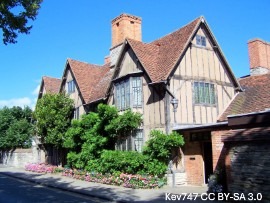
Stratford-upon-Avon home of Shakespeare's daughter is 'At Risk'
Lady Grange’s House repaired on St Kilda
.jpg)
National Trust for Scotland repairs stone cleit with link to famous island resident
Griff Rhys Jones on BBC Radio 4 Today programme
,_Green_Lane,_Derby.jpg)
The Victorian Society’s President unveiled its latest Top Ten Endangered Buildings 2026.
Need a MATE? Book your place now.

IHBC offers free webinars on applying for IHBC accreditation (Full & Associate).
UK Stained Glass Repository finds windows new homes
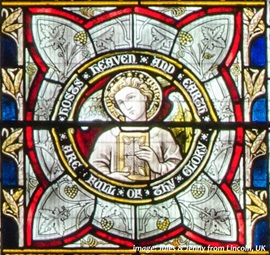
How are stained glass windows are rescued, stored and repurposed?
APPGEBE report sets high aims for quality
'Government must not sacrifice quality in drive to build 1.5m homes'
New measures protect Historic Shipwrecks from heritage crime

Underwater cultural heritage benefits from new HE guidance
How could the City of London skyline look in 6 years' time?

Visualisation shows approved planning applications as completed buildings
National Trust for Scotland calls for VAT cuts
Heritage neglect is encouraged by current policies
IHBC's 'Context' Issue 186 features Industrial Heritage
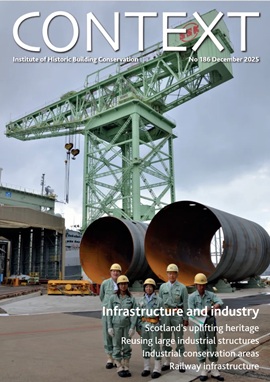
IHBC's members' journal reports on the challenges of conserving infrastructure
Book now for IHBC Annual School 2026
IHBC Annual School is taking place 18-20 June 2026 in Newcastle
RICHeS Research Infrastructure offers ‘Full Access Fund Call’

RICHeS offers a ‘Help’ webinar on 11 March
Latest IHBC Issue of Context features Roofing
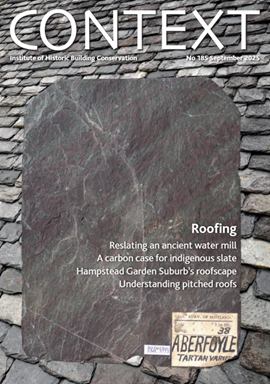
Articles range from slate to pitched roofs, and carbon impact to solar generation to roofscapes
Three reasons not to demolish Edinburgh’s Argyle House

Should 'Edinburgh's ugliest building' be saved?
IHBC’s 2025 Parliamentary Briefing...from Crafts in Crisis to Rubbish Retrofit
IHBC launches research-led ‘5 Commitments to Help Heritage Skills in Conservation’
How RDSAP 10.2 impacts EPC assessments in traditional buildings

Energy performance certificates (EPCs) tell us how energy efficient our buildings are, but the way these certificates are generated has changed.